
Lean Inventory Management: Strategies to Reduce Waste and Excess Stock
 admin
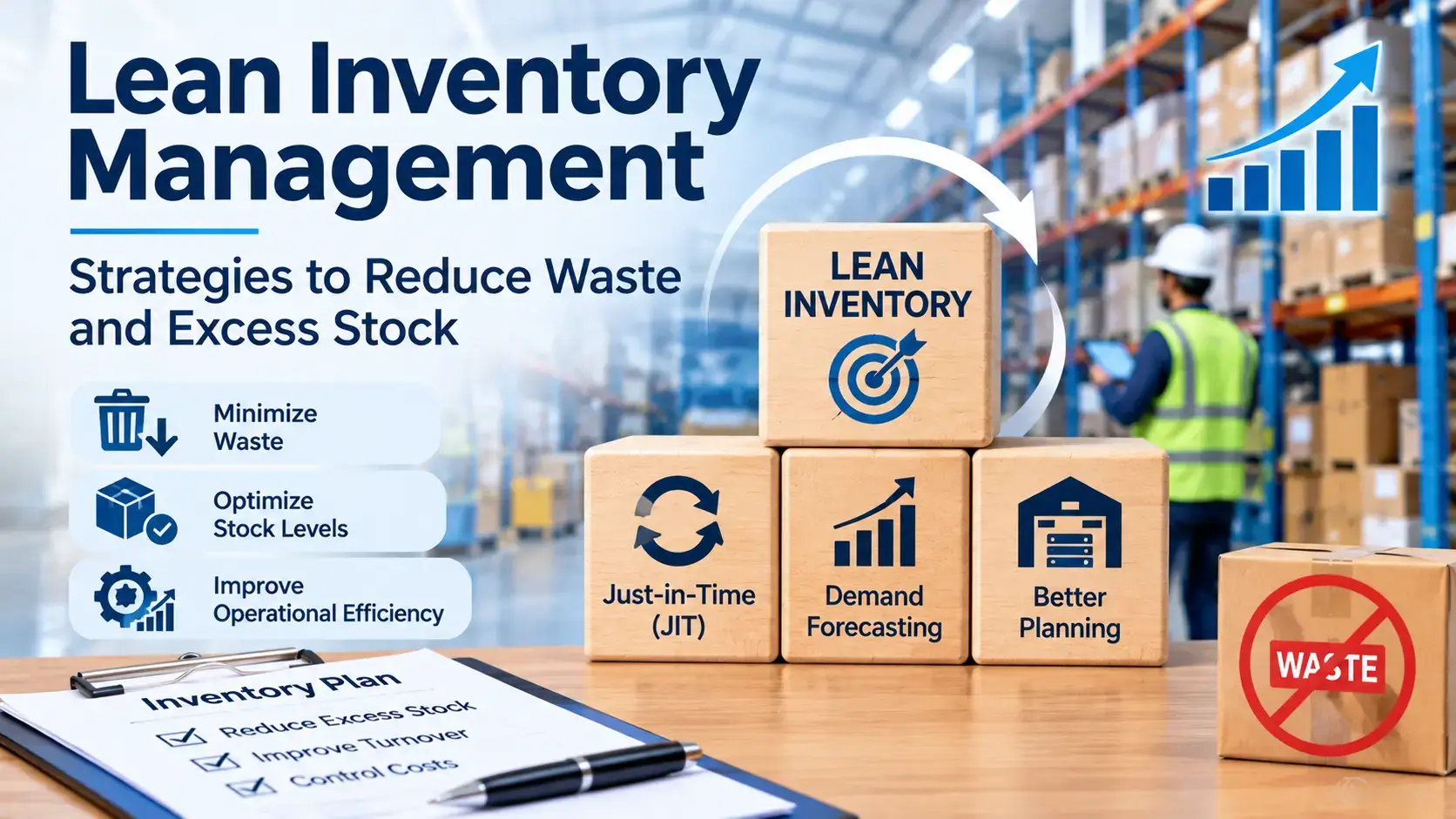
Lean inventory management is the practice of holding only the stock you need, when you need it, so cash, space and time are not tied up in goods that sit still. This guide explains how it works, the strategies that cut excess inventory, the KPIs that prove progress and how ERP software keeps the whole system running on accurate data.
Key takeaways
Lean inventory management applies Toyota-style lean thinking to stock: replenish from real demand, not guesses.
Excess stock is one of the eight classic lean wastes because it hides problems and ties up working capital.
The core tools are just-in-time (JIT) inventory, kanban, ABC analysis, right-sized safety stock and cycle counting.
Lean does not mean zero stock. Smart buffers protect you from supply disruptions.
ERP software supplies the real-time data and automatic reorder rules that make lean practical at scale.
What Is Lean Inventory Management?
Lean inventory management is an approach to stock control that continually removes waste, so a business carries the minimum inventory needed to meet customer demand. It comes from the Toyota Production System and rests on a pull system: goods are ordered or produced because something was consumed or sold, not because a forecast said they might be.
The aim is not the smallest possible stockroom. It is the right stock, in the right place, at the right time, with fewer stockouts and far less money parked on shelves. NetSuite's lean inventory guide describes the same goal: holding only what each production stage needs.
Why Excess Stock Is Waste
Lean lists eight wastes, often remembered as TIMWOODS: transportation, inventory, motion, waiting, overproduction, over-processing, defects and skills. As the 8 wastes of lean explanation puts it, inventory waste is excess material, work in process or finished goods that ties up resources and hides problems.
That cost is rarely small. Holding stock means paying for:
Storage and handling: space, racking, labor and equipment.
Capital: cash tied up in goods that cannot yet be sold.
Obsolescence and spoilage: products that expire, age or go out of fashion, becoming dead stock.
Shrinkage and insurance: loss, damage and cover.
NetSuite's guide notes that carrying costs can reach 30% of inventory value a year. Treat that as an upper-end estimate, since the real rate varies by industry, but it explains why trimming excess stock frees so much cash.
Five Lean Principles That Guide Stock Decisions
Lean thinking rests on five principles that translate directly to stock:
Value: stock what customers actually want and will pay for.
Value stream: map every step from supplier to customer to find waiting, double handling and surplus.
Flow: keep materials moving without piles or stoppages.
Pull: replenish only when demand signals it.
Perfection: keep improving through small, regular changes, known as kaizen.
Lean Inventory Management Strategies to Reduce Waste and Excess Stock
These strategies work best together:
Strategy | What it does | Best for |
Just-in-time replenishment | Orders arrive close to when they are needed | Stable, predictable suppliers |
Kanban | Visual signals trigger replenishment | Repetitive, high-volume items |
ABC analysis | Ranks items by value to focus control | Large catalogs |
Safety stock and reorder points | Sets the buffer and trigger level | Variable demand or lead times |
Economic order quantity (EOQ) | Balances order cost against holding cost | Items with steady usage |
Cycle counting | Keeps records accurate without shutdowns | Every operation |
Supplier collaboration | Enables smaller, more frequent deliveries | Key components |
5S and kaizen | Organizes storage and removes small wastes | Warehouses and shop floors |
Use just-in-time replenishment
Just-in-time inventory means receiving materials close to the moment they are used, so less sits in storage. It requires reliable suppliers, short lead times and accurate schedules, which is why it should be introduced item by item rather than all at once.
Add kanban signals
Kanban uses visible signals, such as cards, empty bins or electronic triggers, to tell suppliers or production to replenish only what was consumed. One kanban case study reports a 25% inventory reduction at the distributor Eriks. Results vary, but the logic is sound: stock is capped, and refills follow use.
Focus with ABC analysis
ABC analysis ranks items by annual usage value. A small share of items, the A items, typically drives most of the value, so they get tight control and frequent review. C items, which are numerous but low in value, get simple rules and larger buffers.
Right-size safety stock and reorder points
A reorder point tells you when to buy: daily usage multiplied by lead time, plus safety stock. One common way to size safety stock is (maximum daily usage minus average daily usage) multiplied by lead time. Review these numbers regularly, because lead time and demand change.
Order the right quantity
The economic order quantity (EOQ) formula balances ordering cost against holding cost: the square root of (2 × annual demand × cost per order ÷ holding cost per unit). Pair it with smaller batch sizes so fewer units of work in process and finished goods pile up.
Keep records accurate with cycle counting
Lean only works if the numbers are right. Cycle counting, which counts a rotating slice of items every day or week, catches errors early without shutting the warehouse for a full annual count.
Collaborate with suppliers
Shorter, more frequent deliveries need suppliers who share your forecasts and signals. Sharing demand forecasting data and agreeing on delivery windows lets you shrink order sizes without risking shortages.
Organize with 5S and kaizen
5S stands for sort, set in order, shine, standardize and sustain. A tidy, labeled storage area makes surplus visible and speeds picking, while small kaizen improvements keep waste from creeping back.
KPIs to Track as You Cut Excess Stock
Measure before and after each change:
KPI | Formula | What it tells you |
Inventory turnover | Cost of goods sold ÷ average inventory | How often stock sells through in a period |
Days of inventory | 365 ÷ inventory turnover | How long stock sits before it sells |
Fill rate | Orders shipped complete ÷ total orders | Whether lean cuts are hurting service |
Carrying cost rate | Annual carrying cost ÷ average inventory value | What holding stock really costs |
Dead stock share | Value of non-moving items ÷ total inventory value | How much waste has accumulated |
Inventory accuracy | Records matching physical count ÷ items counted | Whether your data can be trusted |
A healthy pattern is rising turnover and falling days of inventory with fill rate holding steady. If fill rate drops, you have cut too deep.
Lean Does Not Mean Zero Stock
Lean can backfire when it ignores risk. Very low buffers leave little room for supply shocks, as many manufacturers learned during the 2020 to 2022 shortages. Protect your operation by:
Keeping safety stock on critical, long-lead or single-source items.
Using dual sourcing where one supplier is a single point of failure.
Reviewing buffers when demand patterns or supplier performance change.
The goal is a deliberate buffer, not an accidental pile.
How ERP Software Supports Lean Inventory Management
Lean relies on fast, accurate information, and spreadsheets cannot provide it at scale. An ERP brings inventory, purchasing, sales, production and finance into one database, which supports lean in four ways:
Real-time visibility: live stock levels across locations expose surplus before it becomes dead stock.
Automated reordering: reorder rules raise purchase requests when stock drops below a minimum. Odoo's Inventory app, for example, includes reordering rules alongside Purchase and Sales on the same platform.
Planning logic: material requirements planning (MRP) calculates what to buy and make from real demand. Our guide to ERP vs MRP explains how the two fit together.
Reporting: turnover, aging and carrying-cost reports show where waste is hiding.
If stock lives in several places, a cloud tool with barcode scanning keeps counts current. See our guide to cloud-based inventory management systems for the features and integration patterns that matter.
How to Get Started: A Six-Step Plan
A phased plan keeps risk low:
Baseline your numbers. Record turnover, days of inventory, carrying costs, dead stock and fill rate.
Map the value stream. Follow stock from supplier to customer and mark where it waits.
Segment with ABC analysis. Decide which items deserve tight control.
Clean your data. Fix item masters, units and locations, and start cycle counts.
Pilot one product family. Try kanban or tighter reorder rules for a few weeks and compare results.
Scale and review. Extend what works and revisit buffers on a regular schedule.
Top Remotely's ERP specialists work across Odoo, NetSuite, SAP, Microsoft Dynamics 365 and Oracle ERP Cloud. Our four-step process covers consultation, strategy, implementation and final result, with documentation and training. We support manufacturing, retail and ecommerce and logistics and supply chain businesses. Browse the ERP Resource Hub or estimate your project cost.
Conclusion
Lean inventory management turns stock from a hidden cost into a controlled flow. Map where inventory waits, replenish from real demand, keep buffers deliberate and track turnover, days of inventory and fill rate to prove the gains. An ERP makes the discipline sustainable by giving every team the same live numbers and automating the routine decisions.
Ready to cut excess stock without risking service? Talk to a Top Remotely ERP expert and get a practical roadmap for your operation.
Frequently Asked Questions About Lean Inventory Management
What is lean inventory management?
Lean inventory management is a stock control approach that removes waste by holding only the inventory needed to meet customer demand. It uses pull-based replenishment, accurate data and continuous improvement to cut excess stock, carrying costs and stockouts at the same time.
What are the main lean strategies for reducing excess stock?
The main strategies are just-in-time replenishment, kanban signals, ABC analysis, right-sized safety stock and reorder points, economic order quantity, cycle counting, supplier collaboration and 5S. Most businesses combine several rather than relying on one.
What is the difference between lean inventory and just-in-time inventory?
Just-in-time is one technique within lean. It times deliveries close to use. Lean inventory management is broader: it also covers waste mapping, kanban, data accuracy, supplier relationships and continuous improvement, and it allows deliberate safety stock where risk is high.
What are the risks of going lean?
The main risks are stockouts during supply disruptions, strained supplier relationships and upfront training and software costs. You can reduce them by keeping safety stock on critical items, using dual sourcing and introducing changes in a pilot before scaling.
How does ERP software help with lean inventory management?
ERP software gives live stock visibility across locations, automates reorder rules, runs MRP planning from real demand and reports on turnover and aging. That accurate shared data lets teams cut excess stock without guessing.
Which KPIs show lean is working?
Track inventory turnover, days of inventory, fill rate, carrying cost rate, dead stock share and inventory accuracy. Rising turnover with a steady fill rate shows lean is working, while a falling fill rate signals buffers have been cut too far.
Leave a comment:



2 comments on this post:
Ricky Smith
June 14, 2024It is a long established fact that a reader will be distrac readable content of a page when looking at its layout. The point of using is that it has two.
Joshua Jones
June 15, 2024It is a long established fact that a reader will be distra readable content of a page when looking at its layout. The point of using.